
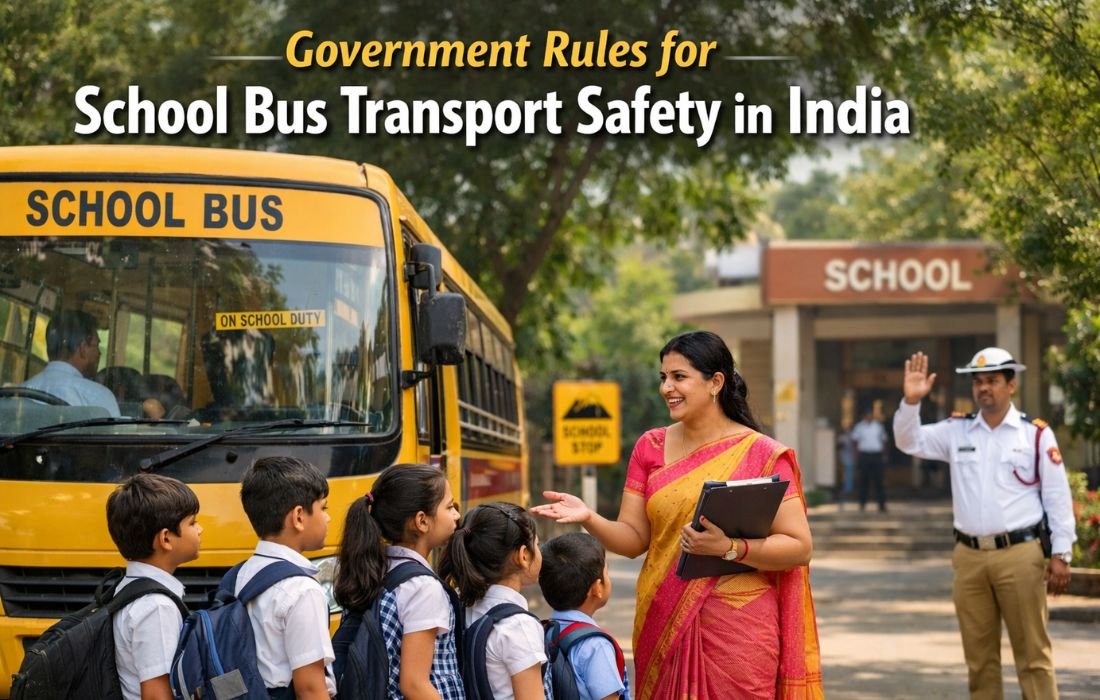
Ensuring the safety and comfort of children during their daily commute to school is the top priority of schools as well as parents. To standardize security protocols, concerned government authorities in India have set some rules for school bus transport safety. All school bus service providers in Noida and across India must follow the issued guidelines by the authorities.
The rules are mainly derived from the Motor Vehicles Act, 1988, directives issued by the Supreme Court of India, the Ministry of Road Transport and Highways (MoRTH), the state transport department/RTO, and CBSE guidelines.
In this post, we’ll talk about the important rules set by the government of India for school bus transport safety.
Governing Bodies for School Bus Safety
School bus safety is not governed by a single body; multiple authorities look over the safety of students traveling through school buses. Here are the authorities that primarily issue guidelines for school bus transport safety in India:
- Motor Vehicles Act, 1988
- Central Motor Vehicles Rules, 1989
- Supreme Court guidelines on school bus safety
- State-specific transport rules and regulations
These rules and regulations collectively ensure the safety, operations, and maintenance standards of school buses.
Mandatory Identification of School Buses
One of the most important and necessary requirements for school buses is proper identification. This includes:
- “School Bus” must be clearly written on the front and at the back of every school bus
- If a school vehicle is hired, it is mandatory to mention “On School Duty”
- The school name and contact number must be clearly visible on the bus
These markings are necessary for the quick identification of school transport vehicles, ensuring timely actions by relevant authorities whenever & wherever required.
Presence of Safety Equipment in School Buses
Another rule that school transport vehicles must follow is to ensure the presence of safety equipment required during emergencies. Here are the safety tools that need to be there:
- First-aid box
- Fire extinguisher
- Horizontal grills on windows
- Secure and reliable door locks
These requirements are made necessary to ensure student safety by the Supreme Court of India, making them compulsory for all school buses across the country.
Presence of Attendant and Supervision
As per the concerned authorities, school buses must have an attendant for proper supervision. Here are the key requirements:
- The attendant must be trained and have enough experience
- It is the attendant’s duty to assist children during boarding and deboarding the bus for safety
- In some cases, a teacher or parent may also travel on the bus
The presence of attendants confirms that younger students are managed well during travel, minimizing the chances of any discomfort.
Seating Capacity and Overcrowding Rules
In India, overcrowding is a key problem in school transport. However, the government of India has issued strict norms to tackle this:
- School bus service providers are strictly advised not to exceed the number of children beyond the permitted seating capacity
- Limited flexibility in the seating capacity may be provided for children below 12 years of age
- No standing passengers should be there on school buses
These rules are made to make school travel safe and comfortable for students.
Driver Qualifications and Responsibilities
The role of the driver is critical when we talk about school transport. The government of India has set a minimal eligibility criterion:
- School bus drivers must have a minimum of 4 years of driving experience for transport vehicles
- Having a valid commercial license is a must
- Drivers must not have a history of any serious traffic violations
- Drivers must follow a set speed limit (generally capped at 40 km/h for school vehicles)
In many states, school bus drivers need to wear uniforms and undergo training regularly.
Vehicle Maintenance and Fitness
It is mandatory for school transportation service companies in Noida and even other states of India to undergo a vehicle fitness check periodically with proper documentation. Here are the key rules that one must follow:
- Maintain periodic fitness certification
- Pollution control compliance
- Ensure the proper functioning of brakes, horn, lights, and tires periodically
- Remove unfit vehicles immediately from the fleet
Concerned authorities conduct regular and even surprise inspections. The presence of non-compliant vehicles may result in heavy fines or suspension. In some cases, stricter actions are taken against violations.
New Safety Features Introduced in Recent Amendments
With evolving technology and safety requirements, the government authorities have updated the safety requirements of school transport vehicles in recent years:
- GPS tracking systems
- CCTV cameras inside buses
- Speed governors
- Emergency exits
These additions improve monitoring and allow parents and schools to track buses in real-time.
Special Rules for School Vans and Cabs
Many parents prefer school vans and cabs for their children instead of school buses. Hence, confirming their safety requirements is also necessary. Here are certain rules that school vans and cabs must comply with as per the authorities:
- School cabs must be painted yellow and are marked with clearly visible “School Cab”
- Speed governors are mandatory
- Proper permits and insurance are required
- Driver verification and background checks are a must
These rules ensure that even private transport services maintain safety standards.
Role of Schools and Authorities
Responsibility for student safety is shared among multiple stakeholders:
Schools
- Must ensure vehicles meet safety standards
- Appoint trained drivers and attendants
- Maintain records and compliance documents
Transport Authorities
- Conduct inspections and enforce rules
- Issue permits and fitness certificates
Parents
- Verify transport arrangements
- Report violations to authorities
In many states, School Transport Committees are formed to monitor safety implementation.
Penalties for Non-Compliance
Failure to follow safety rules can lead to serious consequences:
- Heavy fines
- Suspension of vehicle permits
- Seizure of vehicles
- Legal action against school management
Authorities have adopted a zero-tolerance approach towards negligence in student safety.
Why These Rules Matter?
School bus safety rules are not just legal formalities—they are life-saving measures. India has witnessed several incidents in the past due to negligence, which led to stricter enforcement of these norms.
These rules ensure:
- Reduced accident risks
- Better supervision of children
- Increased accountability
- Peace of mind for parents
Conclusion
School bus transport safety in India is governed by a well-defined framework of laws and guidelines aimed at protecting children during their daily commute. From mandatory safety equipment and trained staff to modern features like GPS tracking, these rules cover every aspect of student transportation.
However, the effectiveness of these regulations depends largely on proper implementation. Schools, authorities, and parents must work together to ensure that every child travels safely to and from school.
In the end, safety is not just a rule; it’s a shared responsibility.
